Ephemeral and Mobile Messaging: The New Spoliation Battleground
Auto-deleting chats and the migration of substantive conversation onto phones have made messaging the most contested corner of ESI. Under Rule 37(e), the question is no longer just whether data is gone — it is whether the loss was reasonable, intentional, and prejudicial. Here is the 2026 landscape.
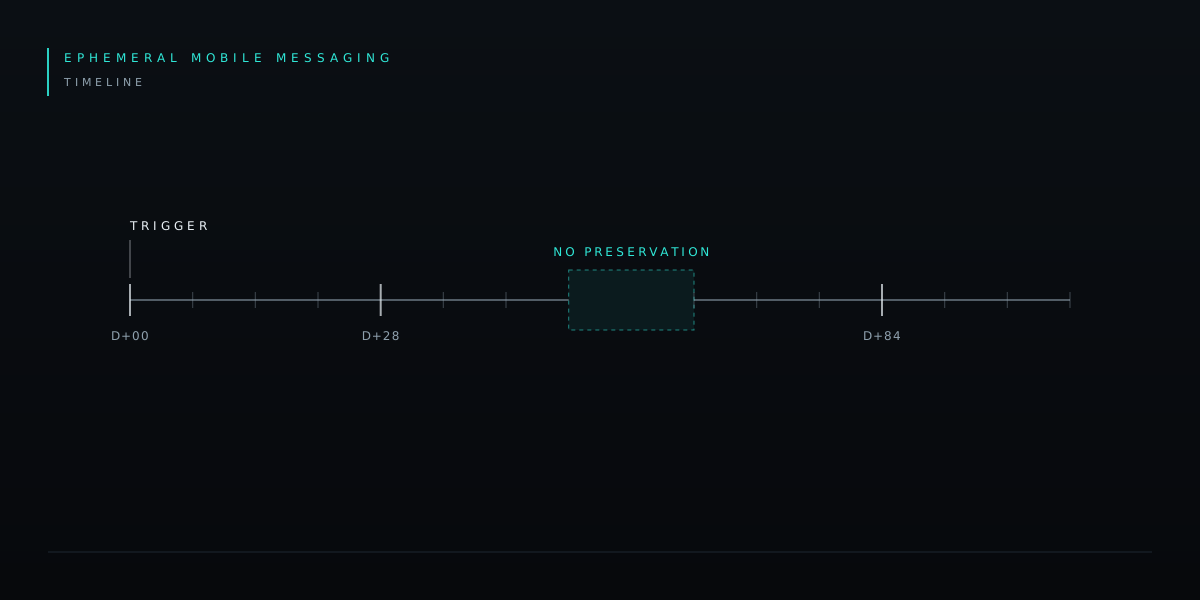
The center of gravity in modern discovery has shifted from email to messaging. Employees coordinate over Slack and Teams, and sensitive conversations migrate to mobile apps with disappearing-message settings such as Signal. When that data vanishes, the dispute lands squarely under Federal Rule of Civil Procedure 37(e), which conditions any remedy on whether reasonable steps were taken to preserve and whether the loss caused prejudice — with the harshest sanctions reserved for intent to deprive.
Auto-deletion is not automatically spoliation
A disappearing-message feature, by itself, is a neutral fact. The Rule 37(e) inquiry turns on conduct: did a litigation hold reach the people and the apps that mattered, and was it enforced? An organization that documented a reasonable preservation effort — disabling auto-delete for relevant custodians, capturing chat exports, imaging devices — stands on very different ground than one whose hold never contemplated mobile data at all.
The intent question
The most severe remedies, including an adverse-inference instruction, require a finding that a party acted with intent to deprive another of the information's use. Courts have shown they will infer intent from the timing and selectivity of deletion — turning on ephemeral settings after a dispute is reasonably anticipated is exactly the pattern that draws scrutiny. A forensic timeline reconstructing when settings changed and when messages were lost is often the decisive evidence.
Where the technical proof comes from
Proving or rebutting spoliation in this space is a forensic exercise. The evidence rarely sits in a single export:
- Device and cloud backups — iCloud, Google, and enterprise MDM systems often retain content the app itself deleted.
- Server-side and admin logs — Slack and Teams retain administrative records of retention-policy changes and message deletion even when the client view is empty.
- App configuration history — when disappearing-message timers were enabled, by whom, and against which conversations.
- Corroborating copies — the same message preserved on a recipient's device or in a screenshot can establish both content and loss.
What litigators should do now
- Scope litigation holds to mobile and messaging platforms explicitly — generic email holds no longer suffice.
- Move quickly to preserve device and cloud sources before routine retention cycles overwrite them.
- Engage a forensic expert early to capture configuration history and build the deletion timeline while it is recoverable.
- Negotiate messaging sources expressly in the ESI protocol so disputes are framed before data disappears.
The prejudice and remedy calibration
Even where loss is established, the remedy must fit the prejudice. An expert opinion calibrated to what was actually lost — and what can be reconstructed from alternative sources — frequently reframes a motion for terminating sanctions into a far narrower curative measure. That calibration is where independent technical analysis earns its keep.
If your matter turns on disappearing messages or mobile data, the preservation and forensic-capture window is short — and the analysis runs through what Rule 37(e) actually requires and how the hold should have reached those custodians. Send the matter details for a conflict check while the sources are still recoverable.
Build the Timeline
Rule 37(e) turns on a timeline someone has to build
Intent, prejudice, and reasonable steps are all proved or rebutted from artifacts — retention settings, admin logs, device images. Send the custodians, the sources, and the key dates for a conflict check while those sources are still recoverable.
Not ready to retain? Track the case law instead.
The ESI Docket — a short bi-weekly digest of the eDiscovery and ESI decisions that actually change how litigators preserve, collect, and produce. No pitches.